




You are viewing 1 of your 2 free articles
Explore the remote Northwest Passage on a HX Expeditions cruise
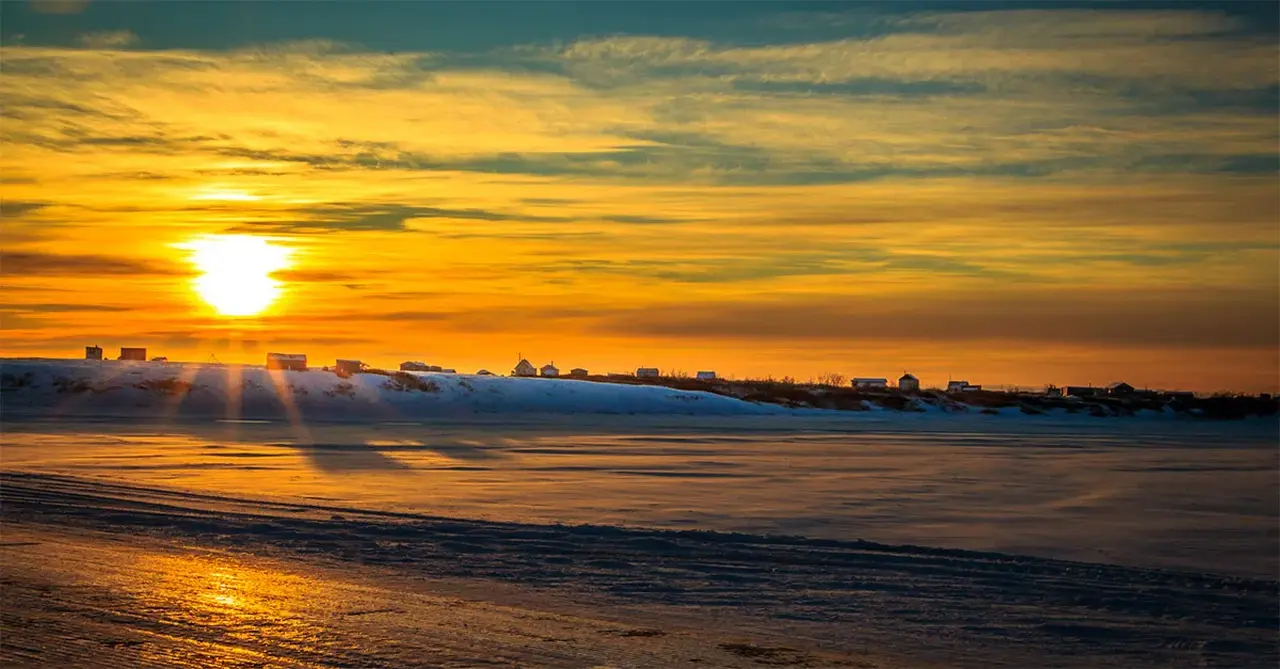
Follow in the wake of the adventurers of old on a rare Northwest Passage sailing

Click here to download and save as a PDF
We’re about to set sail through icy waters on the way the Arctic – but I wasn’t expecting the adventure to start before we even got on board. We’ve just landed in the Alaskan city of Nome to join a cruise through the legendary Northwest Passage.
But it appears that getting on our ship, HX Expeditions’ Roald Amundsen, is going to be a little, shall we say, challenging.
The wind is funnelling down the channel where the ship is docked, causing the sea to spurt up over the gangway. “Now, run,” the crew shouts as we hurry on one by one between each surge.
We made it – but those who decided to look around town before coming on board were left waiting ashore as the wind and waves got worse and the captain made the decision to close the gangway.
Instead of checking into their cabins, they were treated to Nome’s finest pizza while wondering if their expedition had ended before it even started (spoiler alert: it hadn’t. They eventually got on once the weather improved).
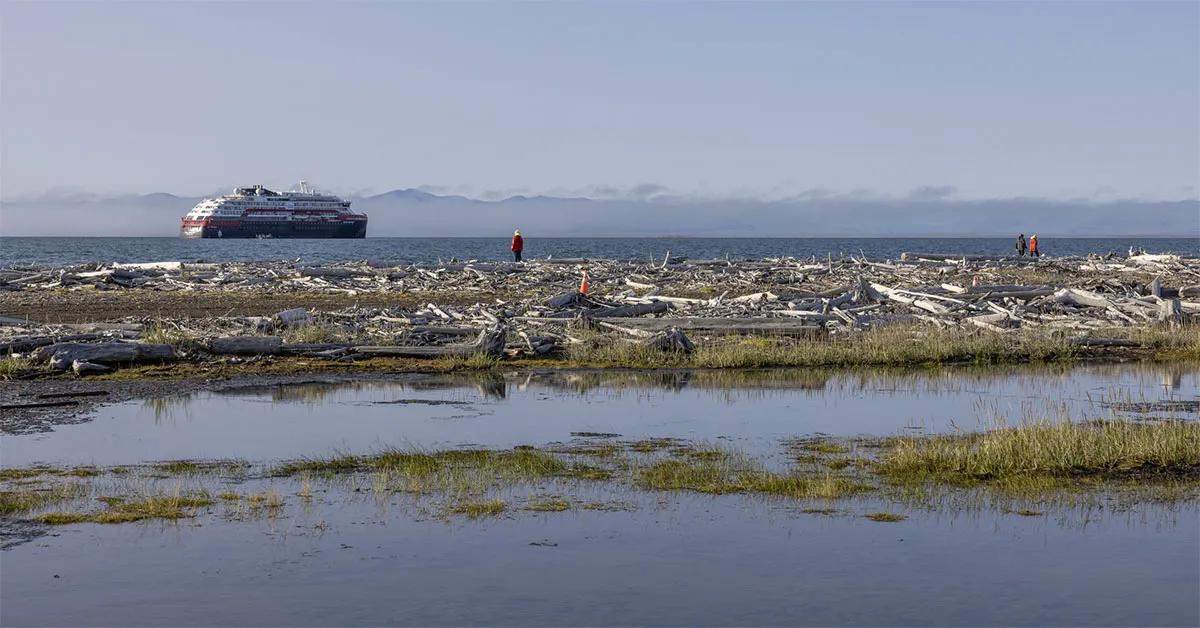
Herschel Island, Canada. Image credit: Oscar Farrera/HX Expeditions
“You have to be flexible, as you have seen,” said expedition leader Torstein at a briefing the next morning, before introducing his team of 22 historians, geologists, glaciologists, marine biologists and ornithologists.
They are here to take us on trips ashore; to hold lectures on history, wildlife and geology; and host citizen science projects that involve looking down microscopes at phytoplankton or looking up at clouds. Some joined us on the forward deck each morning on the lookout for any passing wildlife.
Northwest Passage history
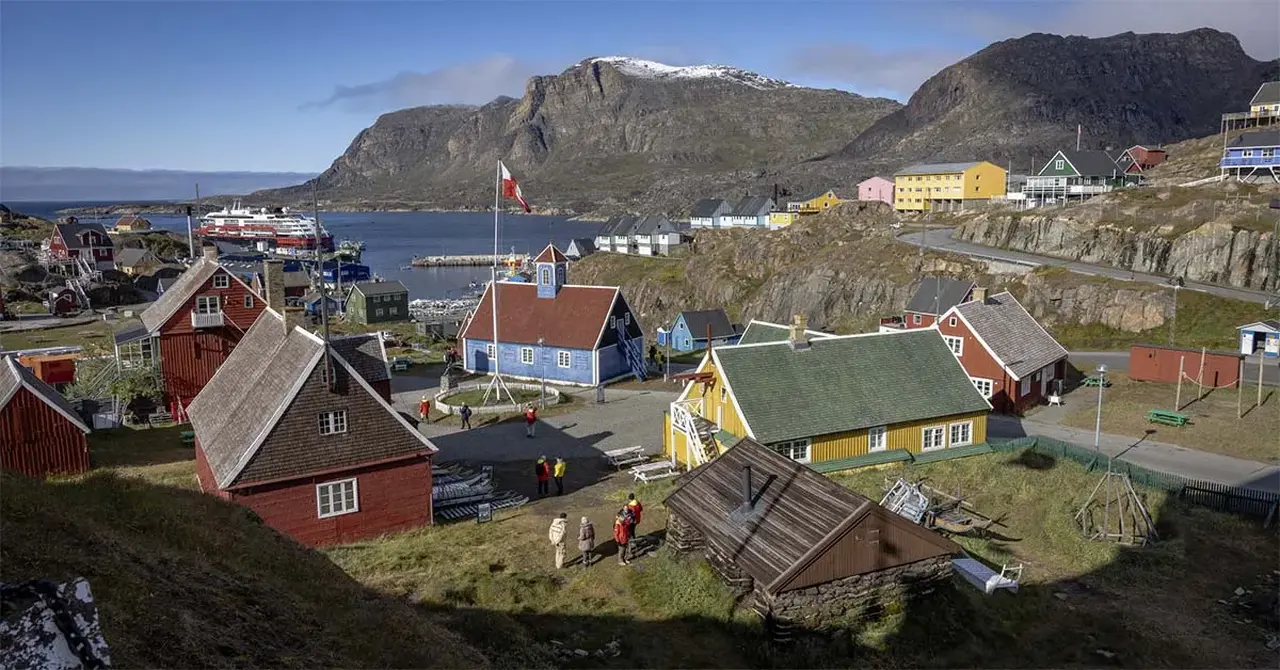
Sisimiut, Greenland. Image credit: Oscar Farrera/HX Expeditions
We were cruising north from Nome through the Bering Strait and across the top of Alaska and Arctic Canada, before diving into a network of channels that eventually lead to Europe.
It’s a route numerous 19th-century explorers tried and failed to find, none more spectacularly than Sir John Franklin, who led an expedition in 1845 that completely vanished.
Various rescue missions established that his two ships, Erebus and Terror, got trapped in ice. Franklin, along with many of the crew, died while survivors took their chances on land. None was ever seen again but the ships were located in 2014 and 2016.
It was another half-century before Norwegian explorer Roald Amundsen, in whose honour our ship is named, made history as the first person to sail through the passage.
Naturally our landing on Beechey Island, where the Franklin expedition overwintered in 1845-46, was a poignant experience for everyone. The temperature was close to zero and the wind was whipping around the bay as we went ashore in inflatable Zodiacs.
We walked around the barren, snowy terrain, spying the graves and cairns where explorers of old left messages under stones as the expedition team, armed with rifles, kept a wary eye out for polar bears.
Ah yes, polar bears. Among the talks was the what-to-do-if-we-see-a-polar-bear advice. Keep calm didn’t seem very realistic, but don’t wander off alone made more sense, which is why, on Herschel Island, it occurred to me while hiking up to a viewpoint on my own that this was not a good idea.
Luckily, all I saw were caribou grazing in the distance.
What to pack for an Arctic cruise
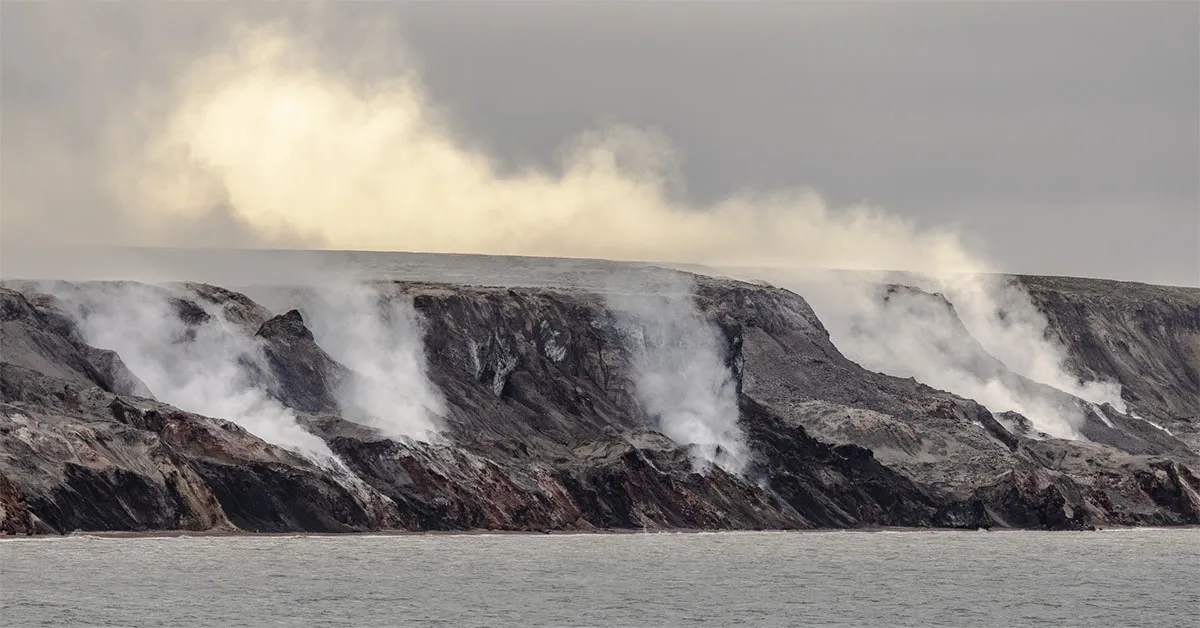
Smoking Hills, Canada. Image credit: Oscar Farrera/HX Expeditions
There is nowhere in the Northwest Passage for ships to dock, so all landings are made by Zodiac, which means stepping into shallow icy water.
Hence waterproof trousers need to be top of the packing list, along with lots of layers (by the time we reached the icy parts of the passage, I was wearing six layers on top and three on my legs) plus gloves, woolly hats and scarves.
HX provides boots and a waterproof jacket (the latter is yours to keep). As life on board is very casual, clients can leave the sparkles at home.
There was great excitement next day as we met sister ship Fridtjof Nansen coming in the other direction and saw the Smoking Hills – so named by Franklin thanks to the sulfur-rich shale that smoulders and gives off plumes of smoke when exposed to air.
That was also the day we entered the Northwest Passage proper. We expected a narrow channel to mark the point but in fact, we were in a vast sea with no sign of land. When we went ashore to uninhabited islands or local settlements, there was not a tree in sight, but a surprising amount of flora despite the icy conditions.
One of the things that makes this cruise so special is that so few people have the privilege of doing it – far fewer than go to Antarctica each year. HX has just two Northwest Passage sailings in 2026. Both are 26 days and are scheduled in August and September when there shouldn’t be too much ice, but this is a wild part of the world so nothing is guaranteed.
“We couldn’t land at Herschel or see the Smoking Hills last year so you’re lucky,” Torstein told me. The luck stayed with us as we also went ashore at Holman Island (Ulukhaktok), Murray Island, Cambridge Bay, Borge Island and Gjøa Haven, where we were welcomed with a traditional Inuit dance.
How to spot polar bears

Polar bear in the Arctic. Image credit: Oscar Farrera/HX Expeditions
Of course, the one thing we all wanted to see was polar bears. This is why, at 6am one morning, I was freezing on my balcony scanning the ice with binoculars where one had been spotted. By now we were in the narrower part of the passage with land close by and sightings were announced ship-wide to make sure no one missed out.
The balcony is one of many perks of the suite life on 490-capacity Roald Amundsen. I also had complimentary laundry; access to Lindstrøm, a more intimate restaurant reserved for suite passengers (non-suite passengers can dine there for €35 a head); and a free minibar, including four bottles of wine.
Non-suite passengers can have breakfast, lunch and dinner at Restaurant Aune, and Fredheim, which was open from noon to 8pm serving burgers, wraps and a sweet Canadian pastry known as BeaverTails. Drinks, other than premium brands, are included for all.
More polar bears sightings followed as we sailed through the narrow Bellot Strait and again at Croker Bay glacier, our last stop before exiting the passage and crossing Baffin Bay to Greenland, giving us a total bear tally of at least 11.
But not everyone was happy. “We haven’t seen much ice,” lamented one passenger as we sailed towards Ilulissat (we had, but maybe she was hoping we’d get stuck in some, like the expeditioners of old). She was in luck.
There was so much of it that our small boat excursion to the mouth of the icefjord was cancelled.
This year’s eastbound Northwest Passage cruise ends in Greenland (for a connecting flight to Reykjavik) but ours continued south to Red Bay and Corner Brook in Newfoundland, where stories of whaling and hikes through the woods awaited. There were also three more sea days before journey’s end in Halifax, which was time for the expedition team to host a quiz to find out who had been paying attention.
Not us apparently; I might not have taken in much scientific knowledge, but if you count polar bear sightings, successful landings on shore and pride in our own sense of adventure, I’m pretty sure we all came out on top.
Book it
HX Expeditions offers a 26-day Northwest Passage – Across the Top of the World cruise from Nome in Alaska to Nuuk in Greenland on Roald Amundsen from £18,663 per person, departing August 10, including pre and post-cruise hotel nights in Seattle and Reykjavik, charter flights from Seattle to Nome and from Nuuk to Reykjavik, drinks, tips and Wi-Fi.
travelhx.com
Shore excursions in the Northwest Passage
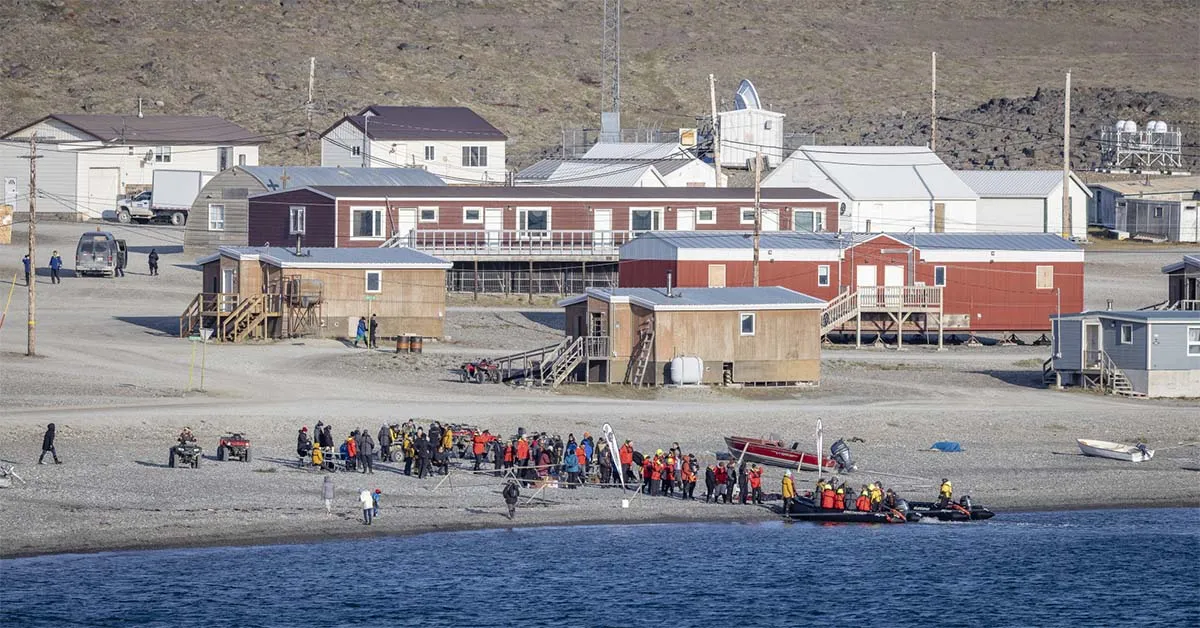
Ulukhaktok, Canada. Image credit: Oscar Farrera/HX Expeditions
Getting passengers ashore in the Northwest Passage is a military‑style operation as all landings have to be on Zodiacs, which hold no more than 12 people. There were 277 on our cruise but the ship can hold up to 490 at full capacity.
Unless visiting Inuit settlements, only 100 passengers were allowed ashore at a time so we were split into groups, taking it in turns to go first. Each group had an hour on land, which was plenty of time to look around.
Lead image credit: Shutterstock/Steven Randel




Jacobs Media is a company registered in England and Wales, company number 08713328. 3rd Floor, 52 Grosvenor Gardens, London SW1W 0AU
© 2025 Jacobs Media
